

Overview
Children will discover how animals use vibrations in different ways
to make sounds and communicate with each other.
Estimated Time and Age Level
Preparation: 30 minutes to prepare stations
Activity: One 30-minute session
(Ages 6-10)
Materials
 Station
Label for each of the six Animal Sound-Off Stations.
Station
Label for each of the six Animal Sound-Off Stations.
2 to 4 pairs of narrow-necked
bottles (try different sizes, shapes and materials)
2 to 4 empty, clean cans with
plastic lids
2 to 4 pencils
2 to 4 aluminum pie tins
2 to 4 small combs
2 to 4 stiff playing cards
2 to 4 thick 4-inch rubber bands
A variety of other objects that
will make sounds by rubbing, shaking, tapping, etc. (rulers, jars enclosing
rattling objects, etc.)
Paper and pencils for each team
to use for taking notes
Preparation
Copy the Station
Labels, cut them out, and tape one near each Sound-Off Station.
Set up all or some of the following
six Sound-Off Stations: howler monkey (bottles, pitcher of water); damselfish
(pencils, can drums); cicada (pie tins); grasshopper (combs, playing cards);
spider (4-inch rubber bands); and an "Invent-Your-Own-Animal-Sound"
station with the other objects you've collected.
Procedure
 Create as many teams as you
have stations. Explain that at each Sound-Off Station, teams will be using
different homemade instruments to mimic the way an animal or insect communicates.
After practicing at each station, children will try to communicate a message
in the "language" of one of the animals represented.
Create as many teams as you
have stations. Explain that at each Sound-Off Station, teams will be using
different homemade instruments to mimic the way an animal or insect communicates.
After practicing at each station, children will try to communicate a message
in the "language" of one of the animals represented.
Without demonstrating each sound, suggest that youngsters look for a single characteristic that connects these "instruments." (Though they may come up with the basic idea, you may have to supply the key word: that these instruments depend upon vibration--moving back and forth in a rhythm to produce sound.) Challenge each team to identify that trait by moving from station to station, taking notes as they go.
 After teams have rotated through
three stations, ask them to stop and discuss what they've observed thus
far. If no team points to the presence of vibrations, give them a clue.
Have youngsters close their eyes and place their hands flat on the floor.
Then drop a heavy book. How did they know the book had fallen? (They heard
it, but they also felt vibrations through the floor. Note: this might not
work if your floor rests on concrete.)
After teams have rotated through
three stations, ask them to stop and discuss what they've observed thus
far. If no team points to the presence of vibrations, give them a clue.
Have youngsters close their eyes and place their hands flat on the floor.
Then drop a heavy book. How did they know the book had fallen? (They heard
it, but they also felt vibrations through the floor. Note: this might not
work if your floor rests on concrete.)
 Now challenge students to give
meaning to the sounds and vibrations they have learned to produce by creating
three distinct messages using the "Sound-Off" device at the station
where they've ended up: a warning of danger, a mating call, and a "Back
off or else!" call. (Or: let them try to communicate another message
of their own design.) Give them time to experiment and then ask teams to
demonstrate their calls to the entire group. Other students (with their
backs turned) can try to guess the meaning of each call.
Now challenge students to give
meaning to the sounds and vibrations they have learned to produce by creating
three distinct messages using the "Sound-Off" device at the station
where they've ended up: a warning of danger, a mating call, and a "Back
off or else!" call. (Or: let them try to communicate another message
of their own design.) Give them time to experiment and then ask teams to
demonstrate their calls to the entire group. Other students (with their
backs turned) can try to guess the meaning of each call.
Assessment
Ask teams to demonstrate to the entire group the animal sounds they
devised at the "Invent-Your-Own-Animal-Sound" station. Judge
according to the originality and accuracy of their efforts. Have the members
of the other teams try to guess the animals being imitated and/or the messages
being sent.
Extension
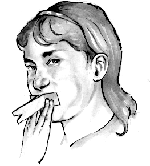
To imitate how human vocal cords vibrate, have youngsters cut a strip
of paper about an inch wide, folding it as shown. They should then cut
out a notch in the folded end, hold it up to their mouth, and blow. Ask
them to experiment with papers of different thickness.
This activity has been copied, with permission, from the National Science Foundation server to ours, to allow faster access from our Web site. We encourage you to explore the original site.